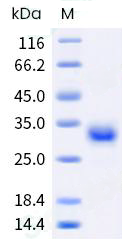


Recombinant Human CD40
The human CD40 extracellular domain is consisted of amino acids 1-194 with a C-terminal polyhistidine tag. CD40 is a receptor protein found on the surface of immune cells, including B cells, dendritic cells, and macrophages. It plays an important role in regulating immune responses, particularly in the activation and proliferation of B cells. When CD40 is activated by its ligand, CD154, it leads to the upregulation of costimulatory molecules and cytokine production, promoting an effective immune response. Dysregulation of the CD40/CD154 pathway has been implicated in various autoimmune and inflammatory disorders, as well as cancer. Targeting this pathway has therapeutic potential for these diseases.

Recombinant Human PD-L1
Price: $299.00
Recombinant Human GITRL
Price: $285.00
Recombinant Human OX40
Price: $299.00